travel app research
conducted user research to explore how a digital product could improve the travel planning process.
the inspiration
almost 20 tabs open on my computer and about 4 different social media apps on my phone, and let's face it—i'm getting nowhere closer to planning my itinerary for the trip i'm embarking on in a few short days. like many, i am determined to maximize the time when i am able to travel to a new place. so when we could choose a topic for my needs and usability assessment course, i knew this was the problem i wanted to explore so that travel planning could be a more efficient, enjoyable, and social experience.
this research explores how a digital product could improve the travel planning process. the intended users are people who love to travel and do so frequently, often seeking ways to make trip planning more efficient, enjoyable, and less overwhelming.

secondary research
before i began to interview potential users, i wanted to ensure that this was actually a product that there was a need for in the travel market. i embarked on conducting secondary research to confirm my hypothesis that there is not currently a digital product that adequately makes the travel-planning process a simple, enjoyable experience.
explains how 1 in 5 americans spend more time planning their travel than they do actually planning their finances, demonstrating how time-consuming travel-planning is.
quora threadusers describe piecing together a next destination from a scattered mix of sources—budget, gut feeling, recommendations, browsing—rather than any single, deliberate process, showing there isn't a centralized place to find necessary information to plan a trip.
skiftexplains how people believe that traveling can be extremely expensive, showing that an app with centralized travel information could be useful in helping plan travel in a more budget-conscious way.
quora threada user who has never traveled before describes wanting to badly but not knowing how to even begin, which displays a need for an app to help make the travel-planning process less overwhelming and more approachable for beginners.
mastersportaltalks about the difficulties of studying abroad and navigating a new environment, demonstrating that this app could be beneficial for those traveling long term, like studying abroad.
overall, this shows a strong need for creating a product that would help make planning vacations a much more enjoyable experience.
recruitment plan
after identifying that there was a market opportunity for this product, i began to create a recruiting plan for my user interviews. i established inclusion and exclusion criteria to support my research goals and ensure that i was interviewing my target users.
inclusion criteria
- anyone aged 17–35 who travels at least 3 times a year
- researches destinations and plans activities for their trips
- enjoys traveling
- uses social media at least 3 times a week
- uses the internet to find travel recommendations and information
exclusion criteria
- does not enjoy or rarely travels
- does not take part in planning their own trips
- does not use social media or has limited access to technology
because i had clear inclusion and exclusion criteria, i also needed a screening process for my interviews. i then wrote a recruitment text with some of the screening questions, which i then sent out to recruit my interview participants, confirming they met my inclusion/exclusion criteria. see my screening questions and recruitment text below!
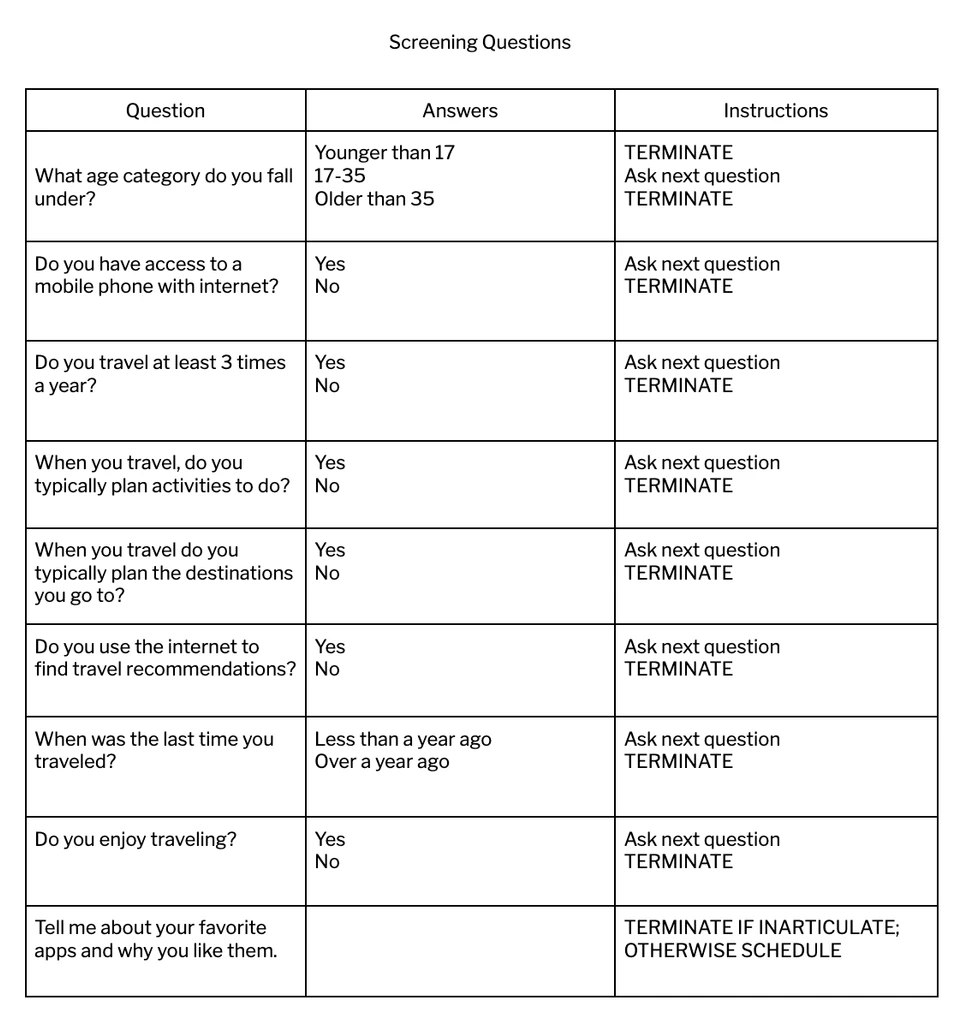
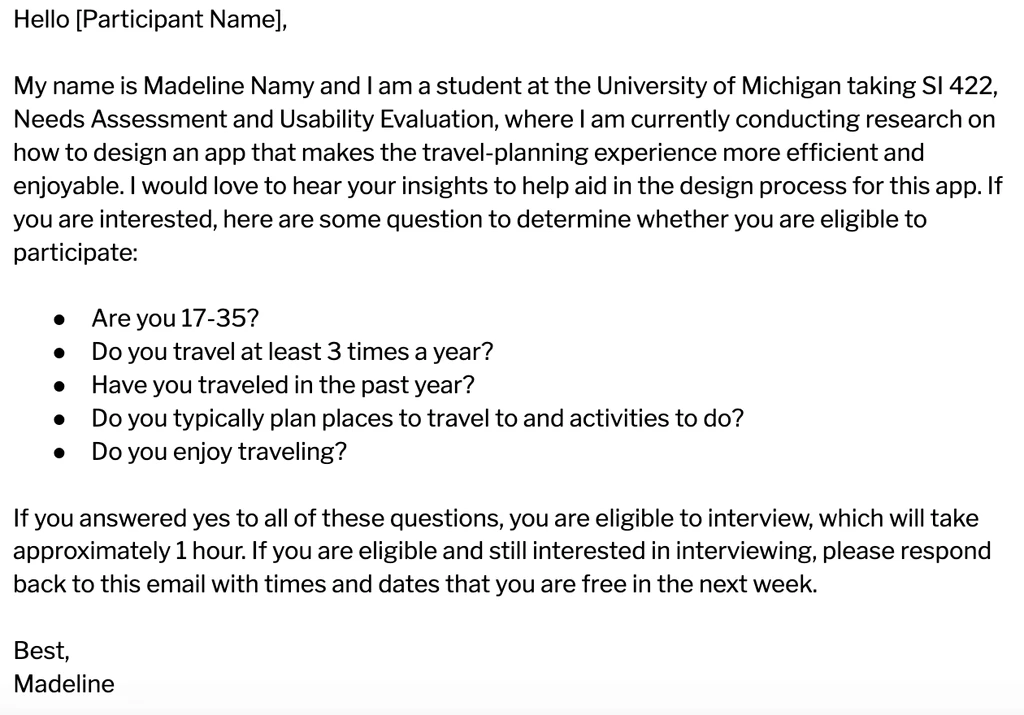 screening questions and recruitment text
interviewing
next, i was tasked with creating an interview guide with 37 questions using the funnel technique. these questions included warm-up questions, general issue questions, deep focus questions, retrospective questions, and wrap-up questions. below are the 37 questions i created for my interview. i also wanted to add a behavioral aspect to the interview to uncover insights that couldn't be captured through attitudinal questions alone. in this activity, i asked participants to plan two activities for an upcoming trip and used probing questions to better understand their behavior and decision-making process.
interview questions
warm-up — ease into the discussion + initial thoughts on traveling:
1. to start off, could you tell me how travel affects your lifestyle?
2. how often do you travel?
3. when was the last trip you took?
4. can you describe the last trip you took and the planning process for that?
5. what are your typical reasons for traveling?
general issues — experiences with traveling:
6. how do you typically go about planning your travel?
7. what is the experience of planning a trip like for you?
8. why do you feel this way?
9. what methods do you use most often to plan travel?
10. what do you like about planning your trips this way?
11. what do you dislike the most about planning your travel this way?
12. what are the most difficult aspects of travel planning?
13. could you tell me more about those aspects?
14. how do these aspects influence how you plan your travel?
15. what problems did you encounter planning your last trip?
16. do you typically have these issues with every trip you plan?
17. how do you feel about the process of planning trips?
deep focus — detailed feedback:
18. based on your problems with travel planning, do you think there are things you can implement into your life to make planning trips simpler?
19. what are those things?
20. how helpful was it to you the last time you received advice from other people when it came to planning trips?
21. could you tell me more about why you thought their advice was helpful?
22. could you tell me more about why you thought their advice wasn't helpful?
23. do you prioritize recommendations from other people when planning trips or prioritize your own research?
24. why do you feel this way?
25. how does talking with other people online affect your own opinions?
user experience:
26. what aspects of social media do you like the most?
27. how does this affect your experience using the app?
28. what aspects of social media do you like the least?
29. why do you feel this way?
30. which features on social media do you typically use the most?
31. what value do these features add to your experience using social media?
retrospective — evaluation in a broader context:
32. reflecting on earlier conversation, how do you think making the process of traveling more social would impact your experience planning trips?
33. how often would you see yourself using the opinions of others to guide the way you plan trips?
34. could you tell me more about when you would see yourself using other people's opinions to help you plan trips?
impact of deep focus discussion:
35. could you tell me more about how making travel planning easier would impact your life?
36. how would you expect simplifying the travel process to impact the experience of actually going on the trip itself?
37. could you tell me more about why you feel this way?
contextual inquiry
in this interview, i will be observing your actions while you plan 2 activities you would like to do on a vacation of your choosing. please behave as you normally would when trip planning. i may interrupt while you perform the task to discuss your actions further. however, if i ever interrupt at a bad time, please let me know when would be a better time to stop.
while you set up your computer, i'm going to ask you a couple of questions to start.
1. how frequently do you plan activities for the vacations you go on?
2. can you tell me about a recent activity you planned for a trip?
3. how do you feel about the tasks pertaining to planning trips before we begin?
i'd first like to start by having you plan your first activity online for a vacation of your choosing. please walk me through each step that you are doing.
1. is this typically how you would start to plan a trip activity?
2. why do you think this?
probes:
6. why did you go to this website?
7. was this the easiest way for you to complete this task?
8. (if no) what would make this task easier to do?
9. why did you search for this when planning an activity?
10. why did you perform this step this way?
11. could you tell me more about why that's important to you?
12. (if they changed their mind during the task) what made you change your mind on this?
13. did you consider anything else that you have not mentioned so far?
14. what specifically did you make sure you checked for when booking this activity?
now, please plan a second activity that you would like to do on vacation. please walk me through your thinking process once again.
15. (if they went about looking for the new activity in a different way) why did you search for this activity differently?
16. (if they went about this in the same way) do you always start to plan activities in this way?
probes:
17. why did you perform this step this way?
18. could you tell me more about why that was important to you?
19. why did you prioritize this when trying to choose an activity to do?
20. do you think you were successful in completing this task?
21. is there anything you wish you did differently when performing this task?
22. (if yes) what did you wish you did differently and why?
23. how do you feel after choosing this activity for your vacation?
24. did you consider anything else that you haven't mentioned so far?
25. how simple did you think it was to plan these activities?
to see my full interview guide, click here.
i also conducted a pilot interview with one user to test out my questions and ensure they would be sufficient for a one-hour session. the pilot went smoothly (phew!), so i moved forward with conducting additional interviews to gather more research data.
when conducting ux research, it was extremely important for me to mitigate bias during the interviews. to do so, i framed questions neutrally by asking “which do you like” instead of “do you like this,” and stayed mindful of keeping a consistent tone and facial expressions throughout each session.
interview coding
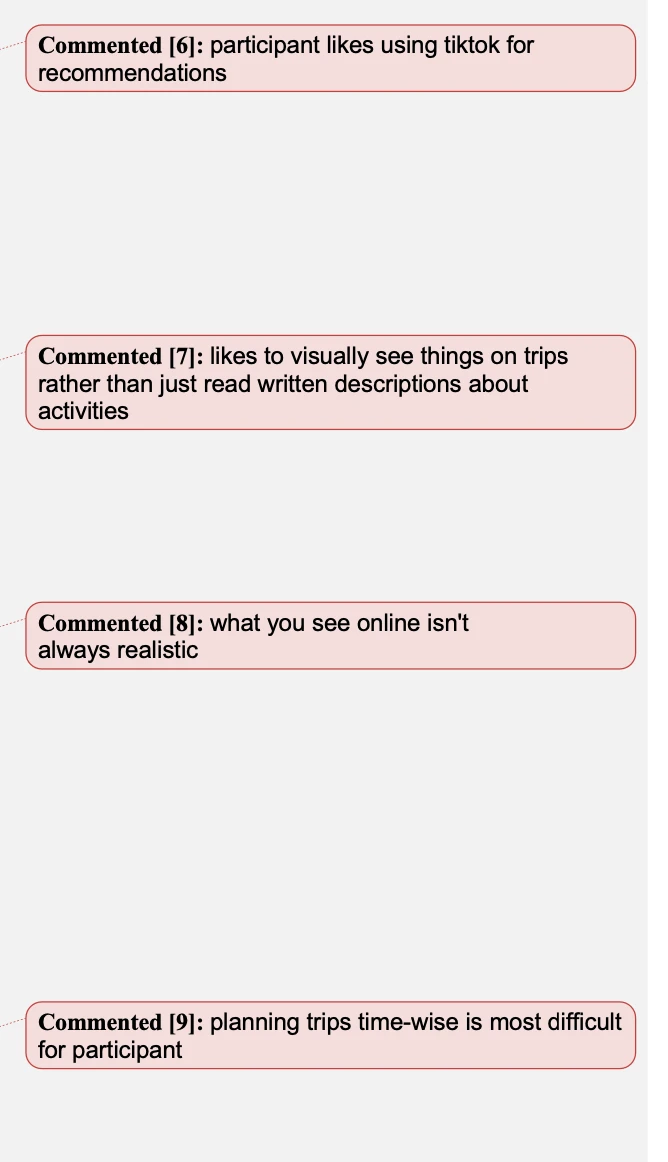
after interviewing and creating transcripts for each participant, i moved on to coding the interview data. these codes were essential for identifying themes and creating my affinity diagrams. to do so, i went through all 5 interview transcripts and added codes to specific quotes, ensuring that i took note of any patterns that formed throughout the various interviews. this is an example of some of the codes i developed from the interview data.
interview themes
once i finished coding all of my interview scripts, i was able to identify key themes based on my user research. i created affinity diagrams to highlight patterns across interviews and uncover insights that would be critical if this app were to be designed.
click a theme to explore the participant quotes behind it.
synthesis
users view travel planning as both exciting and overwhelming. while the process allows them to explore new places and cultures, it is also filled with small, stressful decisions, especially when coordinating with family or friends. nearly everyone starts with google, but planning quickly becomes fragmented, bouncing between tools for budgeting, research, and scheduling.
what users care about most is simplicity, trust, and control. they want reliable information like reviews, affordable options, and tools that reflect their personal preferences. visual content like photos and videos builds excitement and helps them imagine the trip, but social media also adds pressure and comparison, making planning feel performative.
despite different travel styles, the core needs were consistent. users want a way to plan collaboratively, keep track of the details, and make decisions with confidence. furthermore, themes like budgeting, trust, and stress came up consistently across participants, suggesting i reached data saturation in these areas.
but what does this mean for the creation of a digital product?
product implications
- streamline the planning process by centralizing logistics such as budget, bookings, and to-dos in one place
- support collaboration with shared tools for group planning and scheduling
- reduce stress through personalized recommendations and clear, trustworthy reviews
- integrate visual inspiration like photos and sample itineraries without fueling comparison
- build user trust by emphasizing credibility, transparency, and ease of use
this research points to a clear opportunity: a travel planning app that feels personal, organized, and genuinely helpful. it should reduce decision fatigue while keeping the joy of travel intact.
and that wraps up my ux research project!
reflection + next steps
next steps: actually create the product! this research laid a strong, evidence-based foundation for designing a travel planning app. i really enjoyed the process of learning more about different user perspectives and consistently working to view pain points through their lens.
throw assumptions out the window
while this project was originally inspired by my own frustration with the travel planning process, i quickly realized that i wasn't the target user. to conduct unbiased research, i had to set aside my own experiences and focus entirely on what users were actually saying.
users won't always agree, and that's okay
some users had completely different preferences and perspectives, which made the research more complex but also more valuable. this reminded me that no two users are the same, and it's not about finding one perfect solution for everyone, it's about building a product that best supports the overall goal.
prioritize the user first
one of my biggest lessons was recognizing the importance of doing user research before jumping into design. while i eventually gathered valuable insights, conducting interviews earlier would have helped guide the design process more effectively and ensured a truly user-centered approach.